AI Business Consulting: A Practical Roadmap for Turning Automation Into Real Operational Value
Most companies no longer need convincing that artificial intelligence matters. The harder question is where to begin, what to automate first, and how to prove that the investment actually pays off. That is exactly the gap that ai business consulting is designed to close. Instead of selling abstract promises about transformation, a good consulting partner maps your real workflows, identifies the bottlenecks that cost the most time and money, and then builds automation that fits the way your team already works.
This guide walks through what AI business consulting actually involves, how to choose the right first projects, what to measure, and how to avoid the common traps that turn promising pilots into expensive experiments that never reach production. If you are responsible for operations, research, support, sales, or internal knowledge inside a growing company, the framework below will help you move from curiosity to measurable results.
What AI Business Consulting Really Means in Practice
The phrase covers a wide range of work, and that breadth is part of the problem. Some vendors focus on strategy decks. Others focus on building custom models. The most useful engagements sit somewhere in the middle: they start with a clear-eyed assessment of how work currently flows through your organization, then design, test, and implement automation against specific, high-value use cases.
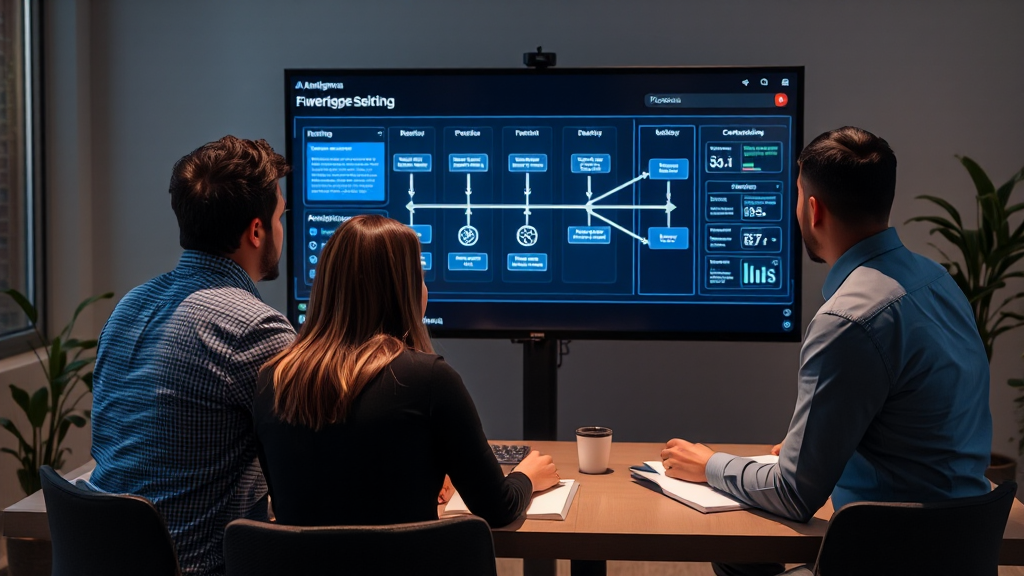
A practical consulting process usually follows four stages. First comes discovery, where the consultant interviews team leads, reviews existing tools, and traces how a request moves from intake to completion. Second comes prioritization, where use cases are scored by business impact, data readiness, and implementation risk. Third comes prototyping, where a narrow slice of the workflow is automated and tested against real inputs. Fourth comes deployment and monitoring, where the automation is integrated into daily operations and measured over time.
What separates effective ai consulting services from generic advice is that every recommendation is tied to a workflow you can point to. If a proposal cannot describe which team, which task, and which metric will change, it is probably too vague to be useful.
Why Operations, Support, and Research Teams Benefit First
AI tends to deliver the fastest visible value in functions that handle large volumes of repetitive, text-heavy, or rules-based work. Three areas consistently show up at the top of the list.
Operations and intake
Operations teams often act as a routing layer, receiving requests from sales, customers, or internal stakeholders and deciding who should handle them. Classification and routing models can read incoming requests, assign categories with confidence scores, and send them to the right queue. This reduces manual triage time and cuts the delay between a request arriving and someone actually working on it.
Customer support
Support is another strong candidate. Drafting responses, summarizing long ticket threads, detecting sentiment, and surfacing relevant knowledge articles are all tasks where language models perform well. The goal is not to remove human agents from the loop but to give them better starting material so they can resolve issues faster and with more consistency.
Research and internal knowledge
Research teams spend enormous amounts of time gathering, cleaning, and summarizing information. Internal knowledge management has the same problem in reverse: the answers exist somewhere, but nobody can find them quickly. A well-designed retrieval system can index documents, policies, and past projects so that employees get grounded answers instead of guessing.
Notice that none of these examples require a dramatic reinvention of the business. They improve work that already happens every day, which is precisely why they are easier to justify and easier to measure.
How to Choose Your First AI Project
The most common mistake in AI adoption is starting with the most ambitious idea instead of the most tractable one. A better approach is to score candidate projects against a simple set of criteria.
Frequency. How often does this task happen? Daily tasks with hundreds of instances will generate measurable savings far faster than rare, high-complexity tasks.
Data availability. Do you already have the inputs the model needs, in a usable format? If the data lives in scattered spreadsheets and email threads, the project will stall before it starts.
Error tolerance. Some tasks can tolerate a wrong answer that a human reviews. Others cannot. Start where a mistake is recoverable.
Clarity of success. Can you state, in one sentence, what improvement you expect and how you will measure it? If not, the project is not ready.
A strong first project typically scores well on all four. A classification model that routes support tickets, for example, is frequent, usually has accessible data, tolerates human review, and has an obvious metric: time to first response. That combination is why so many organizations begin there.
The Role of ai management consulting in Scaling Beyond Pilots
Getting one model into production is a milestone. Getting ten of them to work together without creating a maintenance nightmare is a different challenge entirely, and it is where management-level thinking matters most.
Scaling requires decisions about ownership, governance, and infrastructure. Who is accountable when an automation produces a wrong output? How are prompts, models, and data sources versioned? What happens when a vendor changes an API or deprecates a model? These questions are not glamorous, but they determine whether AI becomes a durable capability or a collection of fragile scripts that break every few weeks.
A useful management framework treats each automation as a product rather than a project. That means assigning an owner, defining success metrics, scheduling periodic reviews, and planning for retraining or replacement as the underlying models evolve. Teams that adopt this mindset tend to accumulate value steadily, while teams that treat each deployment as a one-off often find themselves rebuilding the same logic repeatedly.
It also helps to keep an eye on the broader landscape. Model capabilities, pricing, and tooling change quickly, and a decision that was correct six months ago may no longer be optimal. Following reliable ai news and periodically re-evaluating your stack prevents you from being locked into an approach that has quietly become outdated.
Measuring ROI Without Fooling Yourself
AI ROI is notoriously easy to overstate. A pilot that saves a few minutes per ticket sounds impressive until you multiply it across a team that only handles a handful of tickets per day. Honest measurement starts with a baseline captured before the automation goes live.
Useful metrics fall into three buckets. Efficiency metrics include time saved per task, throughput per employee, and reduction in manual steps. Quality metrics include error rates, escalation rates, and customer satisfaction scores. Strategic metrics include faster time to market, improved retention, or the ability to handle volume growth without proportional headcount increases.
Track at least one metric from each bucket, and review them on a fixed cadence. If an automation is not moving any of them after a reasonable trial period, that is useful information. It tells you to adjust the approach or redirect resources to a better opportunity, rather than continuing to invest out of sunk-cost momentum.
Common Pitfalls and How to Avoid Them
Several failure patterns appear again and again across industries. Recognizing them early saves both time and budget.
Automating a broken process. If the current workflow is chaotic, automating it simply produces chaos faster. Fix the process first, then automate the improved version.
Ignoring the human side. Employees who feel threatened by automation resist it, sometimes passively. Involving them in design and showing how the tool reduces drudgery rather than replacing judgment makes adoption far smoother.
Over-reliance on a single model. Building your entire stack around one provider creates risk. Where practical, design for portability so you can swap components as needs change.
Skipping evaluation. A model that performs well in a demo can fail on real data. Build a test set that reflects actual inputs, including the messy edge cases, and evaluate against it before deployment.
Partners like Amalgama address these pitfalls by designing, testing, and implementing automation that fits the specific shape of a business rather than forcing the business to fit a generic template. That distinction sounds small, but it is often the difference between an automation that survives contact with production and one that quietly gets abandoned.
Building an Internal Capability, Not Just a Dependency
The best consulting engagements leave the client stronger than they found them. That means documenting workflows, training internal champions, and transferring enough knowledge that the team can maintain and extend what was built.
Practically, this looks like shared repositories, clear naming conventions, and runbooks that explain what each automation does and how to troubleshoot it. It also means identifying one or two people internally who can act as the first line of support, so minor issues do not require an external call every time.
Over time, this internal capability becomes a competitive advantage. The organization can evaluate new tools quickly, prototype ideas without lengthy procurement cycles, and respond to changes in the market with confidence rather than hesitation.
FAQ
How long does a typical AI business consulting engagement take?
Most engagements begin with a short discovery phase of two to four weeks, followed by a pilot that runs for another four to eight weeks. Full deployment timelines depend on the complexity of the workflow, data readiness, and how many systems need to be integrated.
Do we need a large technical team to benefit from AI automation?
No. Many high-value use cases, such as document classification, summarization, and knowledge retrieval, can be implemented with modest infrastructure. What matters more is having clear ownership and a willingness to iterate based on real usage data.
How do we know if our data is ready for AI?
A practical readiness check looks at three things: whether the data exists in a structured or semi-structured form, whether it is accessible to the systems that will use it, and whether it is representative of the real-world cases the model will encounter. Gaps in any of these areas can usually be addressed, but they should be identified early.
What happens if the AI makes a mistake?
Well-designed systems include human review for high-stakes decisions and confidence thresholds that route uncertain cases to a person. The goal is to automate the routine majority while keeping humans in control of the exceptions.
Is AI business consulting only for large enterprises?
Not at all. Smaller organizations often see faster returns because their decision cycles are shorter and their workflows are easier to map. The key is choosing a focused first project rather than attempting a broad transformation all at once.
Final Thoughts
AI business consulting is most valuable when it stays grounded in operational reality. The organizations that succeed are not the ones chasing the most advanced models, but the ones that pick specific, measurable problems and solve them well. Start small, measure honestly, and build the internal capability to keep improving. Done consistently, that approach turns AI from an abstract ambition into a dependable source of operational advantage.